Starting an Instagram t-shirt business means building an entire sales operation on a platform designed for discovery, using visual storytelling to attract customers, drive engagement, and convert followers into buyers without needing a traditional storefront. It’s the most cost-effective way to test custom apparel ideas in 2026, requiring minimal upfront investment while giving you direct access to millions of potential customers who already spend hours scrolling daily.
The model works because Instagram combines product showcase, customer service, and checkout in one ecosystem. You create content that resonates with your target audience, build trust through authentic engagement, and guide followers to purchase through your bio link, Stories, or direct messages. Success depends on consistent posting, strategic use of hashtags and Reels, and a clear brand identity that stands out in a crowded feed.
Canadian entrepreneurs particularly benefit from this approach. Sustainability-conscious consumers increasingly prefer buying from small businesses they connect with online, especially when those brands demonstrate transparent production practices and genuine values. An Instagram t-shirt business lets you highlight eco-friendly materials, ethical manufacturing, and the story behind each design in ways traditional retail can’t match.
This guide walks you through the complete setup process, from choosing your niche and sourcing sustainable blanks to creating conversion-focused content and tracking the metrics that actually drive revenue. You’ll learn which tools streamline order management, how to price for profit while staying competitive, and what common mistakes drain time without building your customer base.
What You’ll Need to Start Your Instagram T-Shirt Business
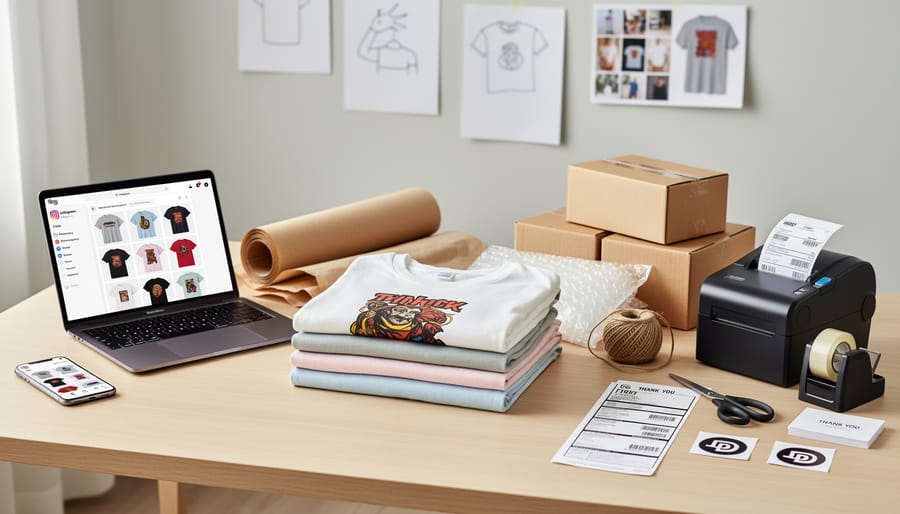
Before you post your first product photo, you need the right foundation. Starting an Instagram t-shirt business requires less upfront capital than a traditional retail store, but it’s not zero-cost or zero-effort. Here’s what you must have in place before launch.
Business Registration and Legal Framework
You’ll need a legitimate business structure. In Canada, most small t-shirt businesses start as sole proprietorships or register a business name with their provincial government. This typically costs $60, $150. If you’re planning significant sales volume, consider registering for a GST/HST number (mandatory once you exceed $30,000 in annual revenue). Beyond registration, you need business banking separate from your personal accounts, this simplifies taxes and looks professional when processing payments.
Essential Tools and Resources
- Instagram Business Account, free conversion from personal account, unlocks Shopping features and analytics
- Design Software, Canva (free tier works), Adobe Illustrator (professional standard), or Procreate for iPad
- Product Sourcing, partnership with a print-on-demand service or relationship with a local screen printer
- Payment Processing, PayPal, Stripe, or e-commerce platform integration for transactions
- Photography Setup, smartphone with good camera, basic lighting (ring light or natural window light), neutral backdrop
- Inventory Management, spreadsheet or simple inventory app if holding stock
Choosing Your Production Model
Your biggest decision is print-on-demand versus bulk ordering. Print-on-demand services like Printful or working with a local printer who dropships eliminates inventory risk, you only pay when a customer orders. The trade-off is higher per-unit costs and less control over materials. Bulk ordering gives you better margins and lets you choose sustainable blanks like organic cotton or recycled polyester, but requires upfront investment and storage space.
For sustainability-focused businesses, vet your production partner carefully. Ask about their fabric sources, printing methods (water-based inks are more eco-friendly than plastisol), and labor practices. Canadian customers increasingly expect transparency here, it’s not just good ethics, it’s good business.
Important Considerations Before You Launch
Before you invest time and money, understand the risks that can shut down your Instagram t-shirt business overnight. Instagram enforces strict commerce policies, violate them and your account disappears along with your follower base and sales channel. Don’t assume you can use any design you find online; copyright and trademark infringement claims can trigger legal action and permanent platform bans.
Canadian sellers must register for GST/HST once annual revenue exceeds $30,000. When to register for GST/HST details your obligations, but track revenue from day one to avoid compliance issues. If you ship across borders, factor in customs duties, import taxes, and cross-border shipping restrictions that can delay deliveries and frustrate customers.
Sustainability claims require proof. Stating your shirts are “eco-friendly” or “sustainable” without verifiable sourcing, certifications, or transparent manufacturing processes constitutes greenwashing, a fast way to damage credibility and face potential advertising violations. Your custom apparel branding must align with genuine practices, not aspirational marketing.
Common fatal mistakes include using Instagram automation tools that violate terms of service, ignoring trademark searches before launching brand names, and failing to maintain required business licenses in your province. These aren’t minor oversights, they’re business-ending risks that careful planning prevents.
Step-by-Step: Building Your Instagram T-Shirt Business
Step 1: Set Up Your Instagram Business Profile for Sales
Your Instagram profile is your digital storefront, and the first 30 seconds a visitor spends there determines whether they follow and buy. Start by converting your personal account to a business profile in Settings, this unlocks analytics, contact buttons, and shopping features you can’t access otherwise.
Once converted, tackle these critical optimization tasks in order:
- Choose a username that’s searchable and memorable, ideally your brand name without numbers or underscores that make you harder to find.
- Write a bio that answers three questions in 150 characters: what you sell, who it’s for, and why it matters. Example: “Sustainable tees for eco-conscious Canadians | Organic cotton, bold designs | Ships from Vancouver.”
- Add contact buttons (email, phone) and your website link, use a link-in-bio tool if you need to direct traffic to multiple pages.
- Enable Instagram Shopping by connecting your Facebook catalog, uploading your products, and submitting for review (approval typically takes 1-3 days).
After approval, you can tag products directly in posts and Stories, turning every image into a clickable purchase opportunity. Test your profile by viewing it as a stranger would: does it immediately communicate what you offer and how to buy? If not, refine your bio and ensure your pinned posts showcase your best-selling designs. A well-optimized profile converts casual scrollers into paying customers without requiring them to leave Instagram.
Step 2: Develop Your Product Line and Brand Identity
Your product line shapes everything else in your Instagram business. Start by defining a specific niche, eco-conscious parents, fitness enthusiasts, local pride themes, rather than trying to appeal to everyone. A focused audience lets you create designs that actually resonate and makes your content strategy far easier.
Source or create designs that speak directly to your niche’s values and aesthetics. You can hire freelance designers, use a design maker tool, or purchase pre-made graphics with commercial licenses. Whatever route you choose, ensure your designs are legally clear, no copyrighted characters, logos, or trademarked phrases unless properly licensed.
Select blank t-shirts that align with your brand values. If sustainability matters to your audience (and it increasingly does), choose organic cotton, recycled blends, or ethically manufactured blanks. Research printing methods, screen printing for larger runs, direct-to-garment for on-demand flexibility, or heat transfer for small batches, and partner with suppliers who can deliver consistent quality.
Establish visual consistency across your entire product line. This means coherent colour palettes, similar design styles, and packaging that reflects your brand identity. Consistency helps you build your brand recognition fast on a visual platform like Instagram, where followers scroll quickly and remember what stands out.
Step 3: Create Content That Showcases Your T-Shirts
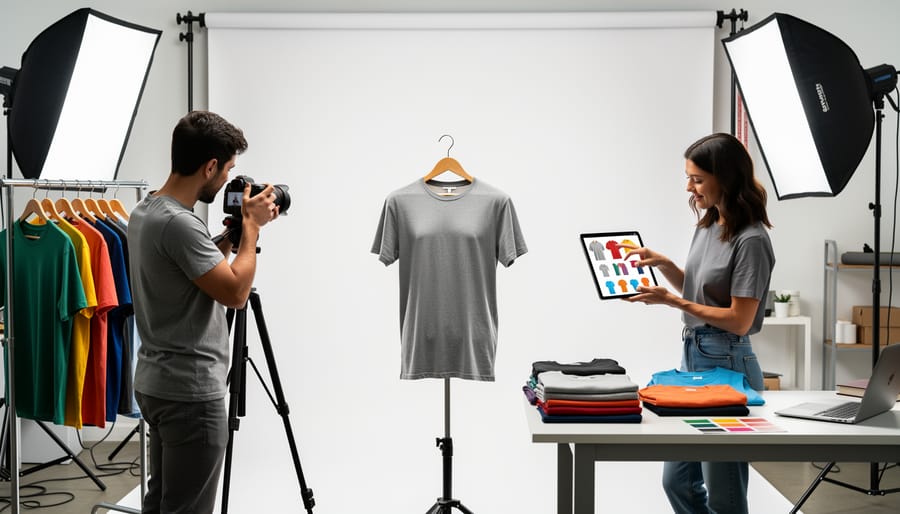
Your Instagram content needs to do one job: make people stop scrolling and want your shirt. Product photography forms the backbone of your strategy. Shoot your t-shirts in natural light near a window, not under harsh overhead bulbs. A clean, wrinkle-free shirt photographed at eye level against a simple background shows quality better than any filter.
Alternate between flat lays and lifestyle shots to keep your feed dynamic. Flat lays work well for showing design details and color options, while lifestyle shots demonstrate fit and styling possibilities. Real people wearing your shirts in authentic settings outperform sterile studio shots every time.
Behind-the-scenes content builds trust and differentiates your brand. Show your production process, from how you design custom apparel to quality checks before shipping. If you source sustainable materials, document that journey. Film short clips of your printing process or packaging orders. This transparency resonates with values-driven buyers who care where their clothes come from.
User-generated content provides social proof while giving you free material. Repost customer photos (with permission) and create a branded hashtag customers can use. Feature customer reviews in Stories with product tags attached. When followers see real people loving your shirts, they imagine themselves wearing one too.
Step 4: Build Your Audience Through Strategic Engagement
Growing your Instagram following isn’t about chasing numbers, it’s about attracting people genuinely interested in what you’re selling.
Start with hashtag research specific to your niche. If you sell eco-friendly graphic tees for yoga enthusiasts, use combinations like #sustainablefashion, #yogalife, and #ecofriendlytees rather than massive generic tags. Mix popular hashtags (100K+ posts) with smaller, targeted ones (5K-50K posts) where your content won’t get buried. Rotate your hashtag sets to avoid looking spammy.
Engage authentically with your target community. Spend 20 minutes daily commenting meaningfully on posts from accounts your ideal customers follow. Ask questions, share genuine reactions, build relationships before you ever pitch a product.
Micro-influencers (5K-50K followers) often deliver better ROI than major accounts. Reach out to creators in your niche with simple gifting collaborations, send them a shirt in exchange for honest content. Their engaged audiences trust their recommendations.
Contests drive discovery fast. A simple “tag a friend who needs this shirt” giveaway expands your reach organically. Make entry requirements light, follows and tags, not complicated multi-platform hoops.
Stories and Reels put you in front of new eyes through Instagram’s algorithm. Behind-the-scenes printing videos, design process clips, and quick styling tips perform consistently well.
Step 5: Convert Followers Into Customers
Once your audience trusts your brand, converting them requires strategic nudges that make purchasing feel natural and rewarding.
Start with product tags in every post and Story featuring your t-shirts. When you tag products, followers can tap to see price and details without leaving Instagram, removing friction from their buying journey. Make tagging seamless: showcase a design in context, then let the tag do the selling.
Limited releases create genuine urgency. Drop a new design with a specific quantity (“Only 50 printed”) or time window (“Available this weekend only”). Scarcity works because your audience knows hesitation means missing out. Just ensure you can fulfill the demand you create.
Turn happy customers into your sales team by sharing their testimonials and photos. Repost customer images wearing your shirts (with permission), and add their reviews to Stories. Real people enjoying your products builds social proof faster than any ad.
Exclusive Instagram discounts reward your community. Share a unique code in your bio or Stories, positioning it as insider access: “10% off for our Instagram family, code INSTA10.”
Every post needs a clear call-to-action: “Shop now through the link in bio,” “Tap to see sizes,” “DM to order.” Tell followers exactly what to do next. Passive scrollers become customers when you guide them there.
Step 6: Fulfill Orders and Deliver Exceptional Service
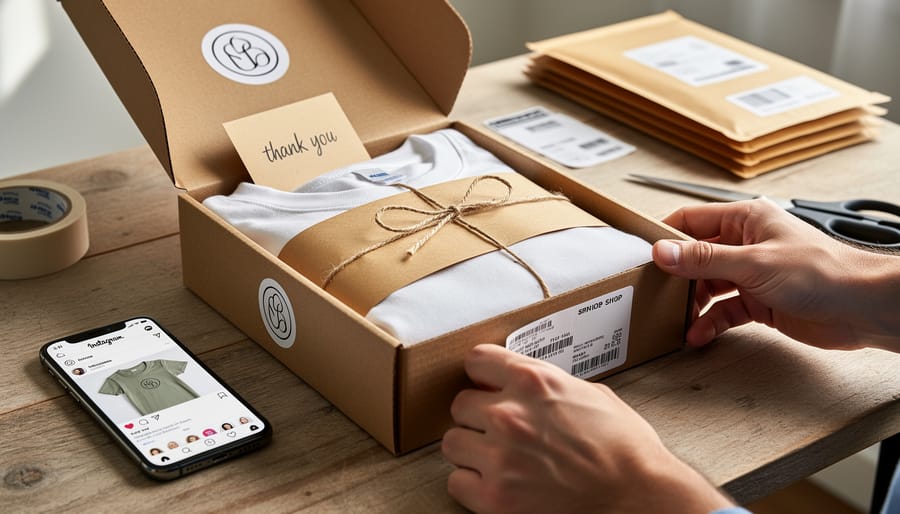
Your workflow starts the moment someone places an order. Set up a dedicated system, whether it’s a spreadsheet, Shopify dashboard, or specialized order management software, to track each purchase from payment confirmation through delivery. This prevents errors and ensures nothing slips through the cracks during busy periods.
Package your shirts in materials that match your brand values. Compostable mailers, recycled cardboard boxes, and tissue paper printed with soy-based ink cost slightly more but reinforce your commitment to sustainability. Include a thank-you card with care instructions and your Instagram handle. Skip plastic poly bags entirely; customers notice and appreciate the difference.
Communicate shipping timelines upfront in your bio and product descriptions. If you’re using print-on-demand, allow 7-10 business days. For pre-printed inventory, you can typically ship within 2-3 days. Send a DM or email with tracking information immediately after shipping, and follow up if there’s any delay. Transparency builds trust faster than speed alone.
Handle DM inquiries within 24 hours, even if it’s just to acknowledge the question and promise a detailed response soon. Common issues, wrong size, shipping address changes, order modifications, are easiest to resolve when caught early. Turn satisfied customers into content creators by encouraging them to share photos wearing your shirts. Create a branded hashtag and repost user content with permission, tagging the customer. This provides social proof and generates authentic marketing material without additional cost.
How to Know Your Instagram T-Shirt Business Is Working
Your Instagram t-shirt business is healthy when the numbers tell a consistent story of growth and conversion. Track these core metrics weekly: engagement rate (aim for 3-5% on posts), conversion rate from profile visits to sales (2-3% is solid for Instagram commerce), follower growth that’s steady rather than spiky, and sales velocity showing repeat purchases. Instagram Insights reveals which content drives profile visits and which posts lead to product page clicks, use this data to double down on what works.
Customer feedback provides the clearest signal you’re on track. When buyers tag you in photos wearing your shirts, share your posts in their Stories, or send unprompted DMs asking about new designs, you’ve created genuine connection beyond transactions. Track which designs sell out fastest and which generate the most questions, this tells you what resonates. If customers mention your shirts in reviews or ask when you’ll restock specific designs, you’ve validated product-market fit.
You’re ready to scale when you see consistent monthly sales increases, regular sellouts of new designs within 48 hours, and customer requests for products you don’t yet offer. This combination signals demand exceeds your current capacity. Consider expanding beyond Instagram when your DMs become unmanageable for customer service, when you’re turning down wholesale inquiries, or when shipping logistics consume more time than content creation. At this stage, a dedicated e-commerce site or partnership with companies that help you create your designs at scale can support growth while you maintain Instagram as your primary marketing channel.
Common Questions About Running an Instagram T-Shirt Business
Do I need a business license to sell t-shirts on Instagram in Canada?
Yes, if you’re operating as a business rather than making occasional sales. Most provinces require business registration, and you’ll need to collect and remit GST/HST once you exceed the small supplier threshold of $30,000 in annual revenue across four consecutive calendar quarters.
How much does it cost to start an Instagram t-shirt business?
Starting costs vary widely depending on your approach. A print-on-demand model can launch with under $500 for design tools, sample products, and initial marketing, while bulk inventory approaches typically require $2,000-$5,000 for initial stock, equipment, and materials.
Can I use print-on-demand services for my Instagram shop?
Absolutely, and it’s often the smartest choice when starting out. Print-on-demand eliminates inventory risk and upfront costs, though profit margins are typically lower than bulk ordering. Many Canadian entrepreneurs test designs this way before committing to larger production runs.
What’s the best way to price my t-shirts?
Calculate your base cost (materials, printing, packaging, shipping), multiply by 2.5-3 for wholesale pricing or 3-4 for direct-to-consumer retail, then compare against competitors in your niche. Factor in the perceived value of sustainable materials or custom designs, which typically command 15-30% premiums.
How do I handle returns and exchanges?
Create a clear return policy before your first sale and feature it in your bio link or highlights. Most Instagram t-shirt businesses offer exchanges for sizing issues within 14-30 days, but limit returns on custom designs to manufacturing defects only.
How important is sustainability to Instagram buyers?
Extremely important, particularly for younger demographics who dominate Instagram shopping. A 2025 survey found that 67% of Canadian consumers aged 18-34 consider environmental impact when purchasing apparel online, and they’ll pay more for verifiable sustainable practices like organic cotton or water-based inks.
These questions represent the practical concerns you’ll face as you build your business, and having clear answers ready builds customer confidence. Address them proactively in your Stories highlights or saved content so potential buyers can find information quickly without reaching out. Transparency about your business practices, pricing rationale, and policies reduces friction in the buying process and positions you as a trustworthy seller rather than just another account hawking merchandise.
Instagram has democratized custom apparel entrepreneurship, letting you test ideas and build a customer base without massive upfront investment. Success hinges on three fundamentals: quality products that people actually want to wear, genuine engagement with your community (not just broadcasting sales pitches), and service that turns first-time buyers into repeat customers.
Start with one or two designs. Launch them. Listen to what your audience tells you through their comments, saves, and purchases. Refine based on real feedback, not assumptions. This iterative approach lets you grow sustainably, both financially and environmentally.
As your business gains traction, consider partnering with established custom apparel companies that handle production while you focus on design, marketing, and customer relationships. The right partnership maintains your quality standards and brand values while giving you capacity to scale. Your Instagram presence is the storefront, make sure what happens behind the scenes matches the promise you’re making to your followers.